

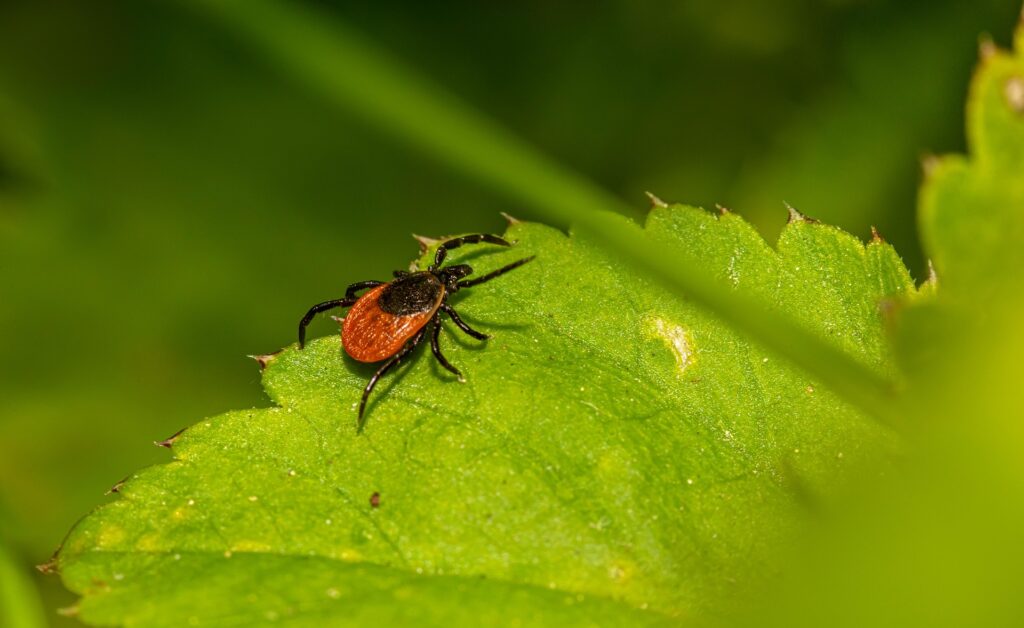
If the latest tick news has you reconsidering outdoor summer activities, you’re not alone.
In April, the U.S. Centers for Disease Control and Prevention (CDC) reported that emergency department visits for tick bites were higher than normal in many parts of the country. They were the highest for weekly rates for the time of year since 2017 for all regions except the south-central United States.
Citizen tick collection programs across the country are also reporting increased tick collection and positive testing for the bacteria that cause Lyme disease.
In Wisconsin, the Marshfield Clinic Research Institute reports that more than half (51%) of deer ticks collected from citizen scientists in 2024 carried the bacteria responsible for Lyme disease — a finding that’s getting attention across the upper Midwest.
In April, the Tick Testing Program at the Connecticut Agricultural Experiment Station (CAES) reported an increasing number of blacklegged “deer” tick submissions to its testing laboratory, also with a higher-than-average Lyme positivity rate of more than 40%.
And the Upstate Tick Testing Laboratory at SUNY Upstate Medical University in central New York also predicted an early and heavy tick season based on submissions.
This isn’t a new problem — it’s a worsening one. Reported Lyme disease cases have increased dramatically over the past three decades, from about 16,000 in the mid-1990s to nearly 90,000 in 2023 — the highest annual total on record. (Note: In 2022, CDC updated its case definition to include probable cases.)
In late May, the U.S. Department of Health and Human Services announced a sweeping plan to combat Lyme disease and other tick-borne illnesses, including a multi-million-dollar tick control pilot program, up to $2.5 million in innovation challenges, and a stated goal of reducing Lyme disease cases by 25% by 2035. The announcement signals that tick-borne disease has become a named federal priority — not just a regional public health concern.
The Power of Citizen Scientists
Tick-borne disease surveillance has a fundamental problem: ticks are small, their habitats are vast, and traditional research methods — dragging cloth through brush to collect specimens — can only cover so much ground. Citizen science programs have emerged as a powerful solution, turning everyday encounters with ticks into a distributed surveillance network.
The programs vary in approach. The University of Rhode Island’s TickSpotters program, running since 2014, accepts photo submissions from across the U.S., Canada, and Mexico, providing each submitter with a free tick ID and risk assessment within 24 hours. Tens of thousands of reports have been collected from every U.S. state.
In New York, SUNY Upstate Medical University’s tickMAP program has tested nearly 35,000 physically submitted ticks since 2019, feeding a public interactive dashboard that clinicians and health departments use to track disease hot spots in real time. In Connecticut, the CAES Tick Testing Program, founded in 1990 following early Lyme disease research in the state, has tested ticks submitted by residents for more than three decades — one of the longest-running passive surveillance records in the country.
Together, these programs are tracking where ticks are, what they’re carrying, and how both are changing — at geographic scale, in real time, with the help of the public.
In Wisconsin, the Marshfield Clinic Research Institute launched the Tick Inventory via Citizen Science (TICS) in the spring of 2024, and in the first two years of the program, researchers received 12,492 ticks from 18 U.S. states and Ontario, Canada. In 2025, deer ticks made up a larger share of total submissions than in 2024 — a shift worth watching given the species’ primary role in transmitting Lyme and other pathogens in the upper Midwest.
Beyond Lyme, TICS also tested for other tick-borne pathogens among 2024 submissions and found:
- E. muris eauclairensis, which causes fever, fatigue, muscle aches, and blood abnormalities: 3% positivity rate;
- A. phagocytophilum, which disrupts normal immune response and can be severe in older adults and immunocompromised people: 9%;
- B. microti, a parasitic infection with similarities to malaria: 9%.
The TICS project has revealed a consistent two-peak submission pattern. In addition to the spring submission surge, the program also saw a second peak in October. We’ll explore what the data shows about fall tick risk in an upcoming post — for now, consider it a reminder that tick activity doesn’t end when summer does.
Go Deeper at Tick Academy
If this data raises questions you want to dig into — whether you’re a researcher, public health professional, educator, veterinarian, pest management expert, or engaged citizen scientist — Tick Academy was built for you.
IPM Institute’s two-day virtual event returns Oct. 14–15, bringing together a diverse community dedicated to advancing knowledge on ticks, tick-borne diseases, and prevention strategies. Day one focuses on veterinary topics; day two covers management and outreach. This year’s keynote speakers are Dr. Jean Tsao and Dr. Nick Ogden.
Students are also invited to present their research in short sessions — a chance to share cutting-edge work and connect with speakers and fellow attendees.

