
Sustainability Standard

Thank you to all who have submitted feedback during the Consultation Phase of the Revisions Process. The survey is now closed.

Find us on LinkedIn and sign up for email updates for news on the Sustainability Standard!

Most sustainability certifications tell you whether you passed. The Sustainability Standard™ tells you how you’re doing — and helps you get better. 

The Sustainability Standard was built in the field — and it shows. 

Developed in partnership with Sysco and built around the principles of Integrated Pest Management (IPM), ​​The Sustainability Standard is one of the most comprehensive sustainable agriculture certifications available. It’s recognized by Walmart, Whole Foods, Kroger, and other major retailers — and it’s designed to do something most certifications don’t: reward continuous improvement, not just compliance. 

What is the Sustainability Standard?

The Sustainability Standard is a sustainable agriculture certification developed by IPM Institute of North America’s Sustainable Food Group. Designed for the full supply chain — farm to facility — it gives growers a way to measure, document, and improve their sustainability practices, and gives buyers confidence that their suppliers are meeting meaningful, verified benchmarks. 

What makes it different: 

Comprehensive coverage: The Sustainability Standard addresses a broad range of environmental and social practices, with a particular focus on advanced Integrated Pest Management (IPM). It also covers soil health, water quality, nutrient and irrigation management, air quality, waste and recycling, energy conservation, worker welfare, and emergency management. This is one of the most thorough frameworks available, and it consistently delivers more than growers find elsewhere. 

A scoring system that captures real performance: Unlike pass/fail certifications, The Sustainability Standard uses a detailed five-point scoring system that tracks progress over time — not just once every three years, but continuously. Certified operations can show buyers what they’re doing right, and where they’re improving. 

Built to work within existing systems: Audits are designed to integrate with food safety audits already in place (such as PrimusGFS), reducing duplication, cost, and burden on participants. 

Built for both sides of the supply chain: Growers get tools to tell their sustainability story. Buyers get tools to verify and track performance across their supplier base. 

Real sustainability isn’t a checkbox. The Sustainability Standard is built for the work behind it. 

From Farm to Buyer: What The Sustainability Standard Delivers

The Sustainability Standard offers a flexible certification for operations of any size. Individual certification is available for single farming operations or facilities. Group certification is available for facilities with internal or quality management systems that include multiple farms or suppliers, certifying that the entire network meets The Sustainability Standard. 

For growers, producers, and packers/shippers, The Sustainability Standard offers: 

  • certification that documents your sustainability performance and communicates it to buyers; 
  • self-assessment tools to identify areas for improvement; 
  • the ability to combine your sustainability audit with an existing food safety audit; 
  • real-time performance tracking across farms and facilities; and 
  • evidence that preserves and expands market access — nationally and internationally. 

For buyers and retailers, The Sustainability Standard offers: 

  • verified assurance that suppliers are meeting meaningful sustainable agriculture benchmarks; 
  • a credible, third-party-verified way to meet sustainable sourcing commitments; 
  • the ability to track, compare, and report on supplier performance across your supply chain; and 
  • continuous improvement tools to share with your supplier base. 

The Sustainability Standard was developed with the people who use it and built for the supply chain that depends on it. 

What to Expect: The Audit Process 

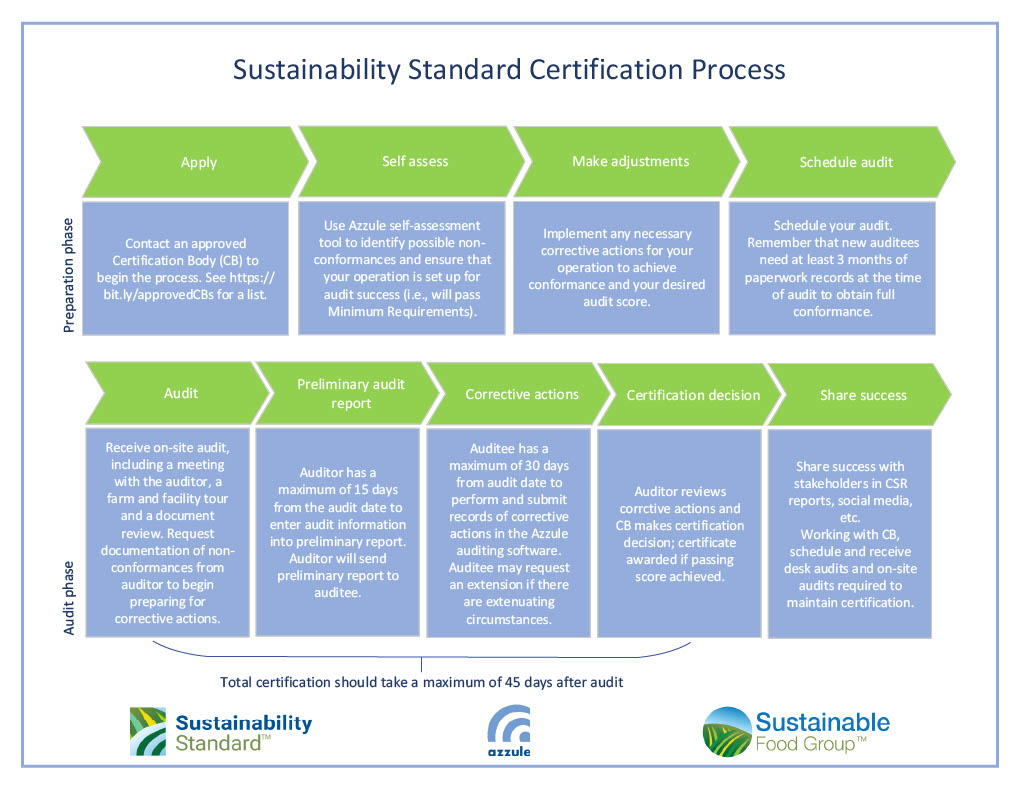
Certification runs on a three-year cycle. An initial on-site audit is followed by desk audits in years one and two, with an on-site recertification audit at year three. Certification is typically issued within 45 days of a successful audit. 

Audits are conducted by an approved third-party certification body — an independent auditing organization trained and authorized to assess operations against The Sustainability Standard. 

Who is Recognizing the Sustainability Standard?

The Sustainability Standard is recognized by some of the largest food retailers and distributors in North America as a verified measure of responsible agricultural production. These retailers have released policies requiring fresh produce suppliers to adopt IPM practices as verified by third-party auditors — and each has included The Sustainability Standard on their list of accepted certifications. 

  • Meijer 
  • Sprouts Farmers Market

Ready to Talk? 

Whether you’re a grower looking to strengthen your market position or a buyer looking for verified sustainability performance across your supply chain, we’re here to help. 

The Sustainability Standard was developed in partnership with Sysco and built with the agricultural expertise of the IPM Institute of North America.  

If you’re a grower or producer ready to pursue certification, your first step is contacting an approved certification body to schedule your audit. See our ​​list of approved certification bodies to get started. 

If you’re a buyer looking to build The Sustainability Standard into your sourcing program, or a grower with questions about whether The Sustainability Standard is right for your operation, contact us. 

The Sustainability Standard is a certification that works as hard as the people using it. 
              

Sign Up for Sustainability Standard Updates.

Sustainability Standard Update Interest Form

Resources

Certification Process

Auditor FAQ

What is the Sustainable Food Group Sustainability StandardTM?

The Sustainable Food Group Sustainability Standard™ is a comprehensive sustainable agriculture certification prioritizing the needs of growers, food companies and the environment. For growers, it provides a meaningful tool to measure, communicate and improve the adoption of sustainability best practices. For buyers, The Sustainability Standard provides assurance that suppliers are adopting best practices related to sustainable agriculture and allows for tracking performance across the supply chain to pinpoint opportunities for improvement.

Who is involved in the Sustainability Standard?

Sustainable Food Group is the scheme owner. Sustainable Food Group is part of the IPM Institute of North America, a nonprofit with over 20 years of experience in implementing sustainability best practices in agriculture. As experts in supply chain sustainability, Sustainable Food Group develops high impact, science-based programs for food industry leaders like Walmart, Sysco, Frontier Co-op and more. Azzule and Primus Auditing Ops are our partners in the development of the Sustainability Standard. Azzule is an industry leader in data management that created the digital platform for auditing and assessing farms and facilities that participate in the program; Primus Auditing Ops is a leading third-party auditing company that is the first certification body to offer on-site audits for the Standard.

What sets the Sustainability Standard apart from other certifications?

The Sustainability Standard addresses environmental, social and quality best practices for agricultural producers, packers and processors, with a focus on Integrated Pest Management (IPM). Self-assessment and certification encourage continuous improvement of sustainability practices, and audits may be combined with food safety audits to streamline the audit process. Additionally, the Sustainability Standard uses a nuanced scoring mechanism in which auditors score each question on a 5-point scale rather than simply pass or fail. This enables more precise scoring and an improved ability to document improvement over time, a key aspect of sustainability.

What are the Sustainability Standard normative documents?

  1. Checklist: A list of questions that comprise the Standard, complete with a space to score each question and to write notes.
  2. Audit Guidelines: An explanation of the scoring system, glossary of terms, and a list of the question that comprise the Standard, including.
  3. General Regulations: Details of the Standard, auditor requirements, certification process, guidance for certification bodies, use of logo and trademark, and more.
  4. Internal Management System Checklist for Group Certification: A checklist against which a Group’s Internal Management System is scored.

How long is the audit cycle?

Audits occurs on a three-year cycle. The initial on-site audit occurs as scheduled by the client; 12 months after that, the first desk audit occurs; 24 months after, a second desk audit occurs; and, 36 months after, an on-site recertification audit occurs and the cycle restarts. See the audit process flowcharts in Program Documents for further details.

Do auditors calculate the points received for each question?

No, auditors award a score between 0 and 5 for each question. The Azzule system calculates the total points awarded for each question.

What are Minimum Requirements and how do they work?

Minimum Requirements are questions that an auditee must pass in order to achieve certification. They cover essential sustainable agriculture practices. A “passing” score for most Minimum Requirements is 5/5; for a few questions it is 4/5 (these cases are defined in the Audit Guidelines).

What is a Group?

In the context of the Sustainability Standard, a Group is a self-designated assemblage of farms or facilities and its suppliers whose products and conduct adhere to a set of standards as designated through an Internal Management System (IMS).

What is an Internal Management System?

An Internal Management System (IMS) is a formalized system of documents processes, procedures and responsibilities to achieve outcomes aligned with the Sustainability Standard. Determined by the IMS holder and adhered to by the Group. The IMS is reviewed annually by the Certification Body.

How does an operation achieve certification?

To achieve certification, an operation must comply with all Minimum Requirements and receive a minimum score of 70%.

What does a Group need to do to attain certification?

To attain certification, a Group must do three things: 1) all audited operations must meet all Minimum Requirements of the Sustainability Standard, including the questions specifically for Group Certification, 2) The average score of all operations in the Group, including farm and facility operations, must be 70% or higher and 3) the IMS for the Group must pass all Minimum Requirements of the IMS Checklist.

Can auditors award a score for a question that is different than the score options outlined in the Audit Guidelines?

For some questions, the Audit Guidelines define scoring options for 0, 1, 3 and 5 points (rather than every value 1 through 5). An auditor can award a score outside of these options; the guidelines are provided to assist in decision-making, and the auditor can use their best judgement based on experience and training to determine what score to award. Auditors are expected to provide their rationale for scores outside of the defined options.

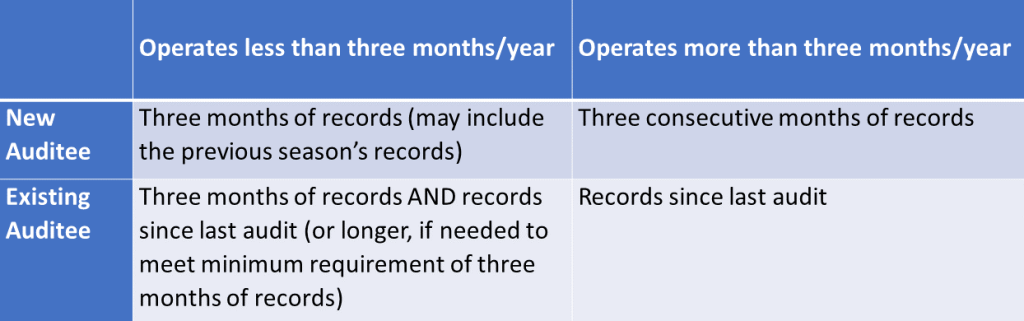
What if an auditee has less than three months of documentation?

If an auditee has less than 3 total months of documentation for review, the auditor cannot award full credit for paperwork questions.

Who do I contact with further questions?

Approved Certification Bodies


Averum logo

Contact

Matt Armstrong

+1 913-643-5000 +5087

Contact

Contact

Isabel Varey


Contact

Marielena Domínguez

+4 521 122 960

Contact

Contact

Kristy-Ann Bura

Certified Organizations


OrganizationCertified CropsFarmsFacilities
Agriproductora de Familia Rancho 22Bell Peppers and Tomatoes (Roma,
Cherry, Cocktail)
Agriproductora de Familia Rancho 22Agriproductora de Familia Rancho 22
Agroexportadora San DiegoMangoesNoneAgroexportadora San Diego
Basciani Foods, Inc. / MD Basciani & Sons, Inc.MushroomsTesta, Masciantonio, Old, New,
Dowell, Woods, Valley 1, Valley 2, Valley 3 and Salerni
Basciani Foods, Inc.
Basciani Foods, FL
Basciani Foods, MN
Basciani Foods, TX
BC Fresh Vegetables Inc.Carrots, Potatoes, Asparagus, Belgian Endive, Broccoli, Cauliflower, Leeks, Shallots, Pumpkins, Squashes, Rhubarb, Beans, Peas, Onions, Garlic, Rutabagas / Swedes, Parsnips, Radishes, Turnip, Kale, Lettuce, Zucchini, Strawberries, Blueberries, Raspberries, Cabbages, Corn, Cucumbers, Brussels Sprouts, Beetroots and Capsicums (Peppers / Chillies)NoneBC Fresh Vegetables Inc.
Canadian Farms Produce Inc., K&A Farms
Billy the Kid Produce, LLCCascabel Chili and OnionsKiddo/Mimbres RanchBilly the Kid Produce, Inc.
BrightFarms, Inc.LettuceGA Greenhouse LLC
TEX Greenhouse LLC
ILG Greenhouse LLC
GA Greenhouse LLC
TEX Greenhouse LLC
ILG Greenhouse LLC
Bybee ProduceOnionsBybee Farms, LLCBybee Farms, LLC
D'Arrigo Bros Co.Leafy GreensRanch 8
D’Arrigo of CA
D‘Arrigo Bros
D’Arrigo Bros Co., of California
Ceuta Produce S de RL de CVTomatoes, Cucumbers, Capsicums (Peppers / Chillies) and EggplantCeuta
Tayoltita
Caimanes
Campo 5
El Capule
Bellavista
Empaque Ceuta Produce
Enrique Antonio Aguirre BañosAvocadoesLa Rosa de San Agustín
La Capilla 10
La Olla
Cutzarondiro 1-5
Piñon 1-9
Las Palomas 1, 2, 3 and 5
La Rosa 8
San Agustin 2
Las Juntas
Huertas Alamo 1-4
Las Palmas Verdes 2
Montaña de las Luces 1-4
La Aurora Max
La Aurora Mini
Pedregal 1
Pedregal parte Baja
Casa de Madera
Rincón de Obregón
None
Farmers Fresh Mushrooms, Inc.MushroomsFarmers Fresh Mushrooms (Abbotsford)
Farmers Fresh Mushrooms (California)
Farmers Fresh Mushrooms
(Abbotsford)
Farmers Fresh Mushrooms
(California)
FirstFruits Farms, LLCApples and CherriesFirstFruits Farms, LLC – PrescottFirstFruits Farms, LLC – Packinghouse
Fresh Local Produce of OhioArugula and Green & Red
Lettuce
Fresh 'n Crisp FarmsFresh 'n Crisp Farms
Frutival S.A. de C.V.AvocadoesNoneFrutival
Gargiulo, Inc.TomatoesGargiulo Inc. Farms 1-6
Gargiulo Inc. Farms 7-9
Gargiulo Inc. Manning
Gargiulo Inc. Russell
Gargiulo Immokalee Packing
Gargiulo Naples Packing
Gargiulo, Inc. (CA)
Giorgio FreshCompany (Blandon)MushroomsGiorgio Mushroom CompanyGiorgio Fresh Company
Golden West ProduceOnionsGW Farms, LLC.Golden West Produce
Greenhouse Grown Foods Inc.Cucumbers, Bell Peppers and
Tomatoes
NoneGreenhouse Grown Foods Inc
Grimmway FarmsCarrotsGrimmway FarmsGrimmway – Malaga Fresh Facility
Grimmway – Premier Facility
Hortalizas SINEXP S. de R.L. de C.V.Chilli Chutney, Capsicums
(Peppers / Chillies), Onions, Tomatoes and Flat Green Bean
NoneHortalizas SINEXP S. de R.L. de C.V.
Hortifrut Peru, S.A.CBlueberriesHortifrut Peru, S.A.CNone
Jensen Farms Produce, Inc.OnionsNoneJensen Farms Produce, Inc.
Jensen Farms, Inc.Potatoes and OnionsAJ Farms, Inc.
Jensen Farms, Inc.
Lucky J's Farms
None
Keystone Potato Products, LLCPotatoesNoneKeystone Potato Products, LLC
LC Mammoth, LLC (Lemonica)Lemons, Grapefruit and
Mandarins
Santa Monica 1
Santa Monica 2
None
Mastron Enterprises Ltd.Bell PeppersMastron EnterprisesMastron Enterprises Ltd.
Monterey Bay FarmsGreen Leaf, Iceberg Lettuce,
Romaine Lettuce, Napa Cabbage, Bok Choy and Brussels Sprouts
Harden RanchNone
Nature Fresh Farms IncBell Peppers, Tomatoes and
Cucumbers
Nature Fresh - Phase 3, 4, 6, 7, 8Nature Fresh Distribution Centre
Naturipe Berry GrowersStrawberriesMeridianNaturipe Berry Growers, Inc.
New Carrot Farms, LLC dba
Bolthouse Fresh Foods
CarrotsNew Carrot Farms, LLC dba Bolthouse Fresh Foods (CA, WA)New Carrot Farms, LLC dba Bolthouse Fresh Foods (CA, WA)
Nos Vigeo Inc., dba Vigeo GardensMicrogreens, Wheatgrass, Herbs, Lettuce and MushroomsVigeo GardensVigeo Gardens – Akron
Pacific Tomato Growers, Ltd.Conventional
and Organic Tomatoes
Immokalee Farm
Georgia Farm
Parrish Farm (Farm 1)
Vitanova Fresh Produce
SMFF Farm
301 Packinghouse
Palmetto Packinghouse
Vitanova Fresh Produce
Midway Packinghouse
Newport Packinghouse
Pero Family Farms Food CompanyGreen Bean and French BeanNonePero Family Farms - PA
Pero Family Farms - FL
Pure Hothouse Foods, a division of Pure Flavor Farms LPTomatoes and CucumbersPure Hothouse Foods, a division of
Pure Flavor Farms LP
Pure Hothouse Foods, a division of
Pure Flavor Farms LP
Rancho La Memoria S de RL de CVTomatoes and CucumbersCampo Milagro
Campo Santa Fe
Campo Palomas
Empaque Rancho La Memoria
Rigby ProducePotatoesImperial FarmRigby Produce
Rigby Produce Inc. - Hamer Division
RioValley Onion, LLCOnionsLack Farms, Inc. Kit Carson
Farms, Inc.
None
RV Aguacates SA de CVAvocadoesNoneRV Aguacates SA de CV
Serg Agricola S.P.R. de R.L.CucumbersCampo MelissaNone
South Mill MushroomMushroomsWest GroveSouth Mill Mushroom, LLC
Sterman Masser, Inc.PotatoesSterman Masser, Inc.Sterman Masser, Inc.
Sun Glo of IdahoOrganic and Conventional
Blackberries, Blueberries, Raspberries and Strawberries
Crapo FarmsSun Glo of Idaho
Sunkist Growers, Inc.CitrusInestroza-1
Inestroza-2
Porterville Citrus Inc. - Lindsay
SuntreatOranges, Mandarins and LemonsGriffith FarmsSuntreat Packing and
Shipping
Taylor FarmsLettuce and VegetablesSan Justo
Vierra
Young
Swale
Home
Freyer
Mills
Garin
Merrill
Clement
Johnson
Foletta
Las Colinas Ranch (2, 4n, 4s)
Clough
Brown
Wickstrom
Feeney
Botelho
Dowdy
Taix
Prescott
Breen 2
Silva
Abbott St.
The DiMare CompanyTomatoes, Roma TomatoThe DiMare CompanyThe DiMare Company - Newman
The Nunes Company, Inc.Iceberg and Romaine LettuceGularte RanchNunes Cooling, Inc.
Watsonville Produce Inc.Spinach, Spring Mix, Arugula, Kale and CilantroNoneWatsonville Produce Inc.
Windset Farms California Inc.TomatoesWindset Farms California Inc.Windset Farms California Inc.

Training Center Program

Training is a required part of the auditor approval process for the Sustainability Standard and is an option for clients or other parties interested in thoroughly understanding Sustainability Standard requirements and procedures. To increase the availability of such training events, Sustainable Food Group is offering a Training Center program. In this program, organizations other than Sustainable Food Group may be approved to conduct Sustainability Standard trainings.  

Approved Training Centers may offer two types of training: 

  1. Sustainability Standard Auditor Training: For third-party auditors of approved Certification Bodies who will be conducting on-site and desk audits of organizations seeking or maintaining Sustainability Standard certification. This training is also suitable for personnel who will be conducting internal Group assessments (i.e., internal audits) as part of the requirements for Group certification.  
  2. Sustainability Standard Client Training: For clients interested in gaining a greater understanding of the Sustainability Standard requirements, normative documents and audit procedures.  

Training Centers may also be Certification Bodies for the Sustainability Standard scheme, but do not have to be. Detailed expectations for training events, including record keeping, promotion, Training Center conduct and trainer requirements can be found in the Training Center General Requirements. The Training Center General Requirements and Training Center Application are both available in the Program Documents section. 

Approved Training Centers

Links to access training events will be provided here once training centers have been onboarded.

Approved Training Centers

Contact

Training Calendar

Frequently Asked Questions

General Questions

For Growers, Producers & Packers/Shippers

For Auditors & Certification Bodies

For Buyers & Retailers

To Learn More, Please Contact