
Commercial Fruit Growers Share Practical Knowledge
February 9th, 11th, 16th and 18th 2026 | 4:30 PM- 7:30 PM Central Time

The Organic Apple Orchard Academy is a premier virtual event hosted by the IPM Institute of North America and the Organic Fruit Growers Association. This course will benefit anyone interested in learning more about managing a small orchard and will include content on site selection/site prep, orchard design and layout, varieties and rootstock, horticultural practices, marketing and organic approaches to pest management.
The Academy is ideal for any beginning grower, conventional or organic, beginning farm manager or someone on your existing farm staff stepping into a management role. This course requires some basic understanding of growing apples; pre-course reading, homework and handouts are included.
Included with your registration:
- Four evening sessions of content from experienced growers
- Optional networking sessions on Tuesday, February 10th and 17th, 6:30 – 7:30 PM
- List of resources to support new growers before and after the event
- A chance to win a quad pollination hive from Koppert US
- $25 off a CoolBot (walk-in cooler controller) or CoolBot Pro purchase
Secure your spot today for just $300—or only $275 for Organic Fruit Growers Association members.
Registration for Organic Apple Orchard Academy has closed.
Schedule at a glance:
Day 1: Startup and Orchard Design
– Rootstocks, tree size, and tree spacing
– Tree support and trellises
– Irrigation systems
– Site preparation before planting
– Variety selection for the organic orchard
– Planting new trees vs taking over an existing orchard
– Buying or grafting your trees
– Orchard design mistakes to avoid
Day 2: Pest Management
– Organic management of the major orchard pests
– Scouting and monitoring for pests
– Selecting a sprayer for your orchard
– Costs and labor for pest management
– Tailoring pest management to fit your market
Day 3: Horticultural Practices, Harvest and Labor
– Planting trees
– Managing the orchard floor: mowing, mulches, & cultivation
– Nutrient management, including soil and leaf tissue testing
– Pruning methods for different sized trees, including restoration of abandoned orchards
– Pollination and organic approaches to thinning and cropload management
– Harvest, including typical yields
– Techniques and tools for handling, grading, and storing fruit after harvest
– Labor needs on small to mid-sized commercial organic orchards
Day 4: Marketing and Overall Summary
– Marketing organic apples: market outlets, pricing, and the challenges of selling locally grown organic fruit
– Value-added processing: choice of products, costs and benefits
– What are the most important areas to focus on in the organic apple orchard?
– Biggest mistakes and best decisions from the farmer-presenters
– Is organic certification worthwhile?
– Combining organic apples with other farm enterprises
Speakers
Chris McGuire, Blue Roof Orchard
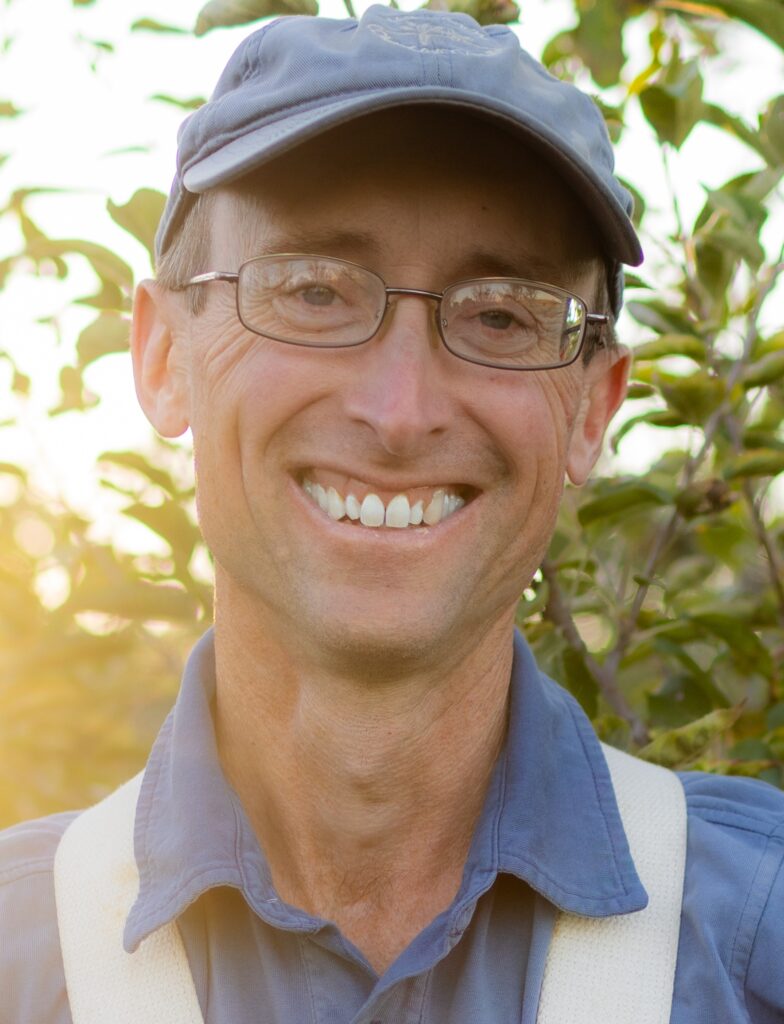
Chris McGuire and his wife Juli operate Blue Roof Orchard in Belmont, WI, where they raise four acres of organic apples. They began farming in 2003 and raised mixed organic vegetables for many years before transitioning to apples from 2012-2018. Their apple orchard consists of over 35 varieties, emphasizing modern disease-resistant varieties, grown on dwarf rootstocks in moderately high-density plantings. Chris and Juli primarily aim to raise quality fruit for fresh eating, which they sell to CSA farm members and grocery stores, but also sell blemished fruit to processors and chefs and produce their farm’s brand of applesauce and apple butter. In addition to farming, Chris also works as coordinator at the Organic Fruit Growers Association, where he facilitates knowledge sharing among fruit farmers and works with OFGA farmers and scientists to coordinate research into organic fruit growing. He has taught over fifty workshops and classes for farmers. Chris believes deeply in the value of farmers passing on their experience and knowledge, and he looks forward to sharing his love for organic apple growing at this school.
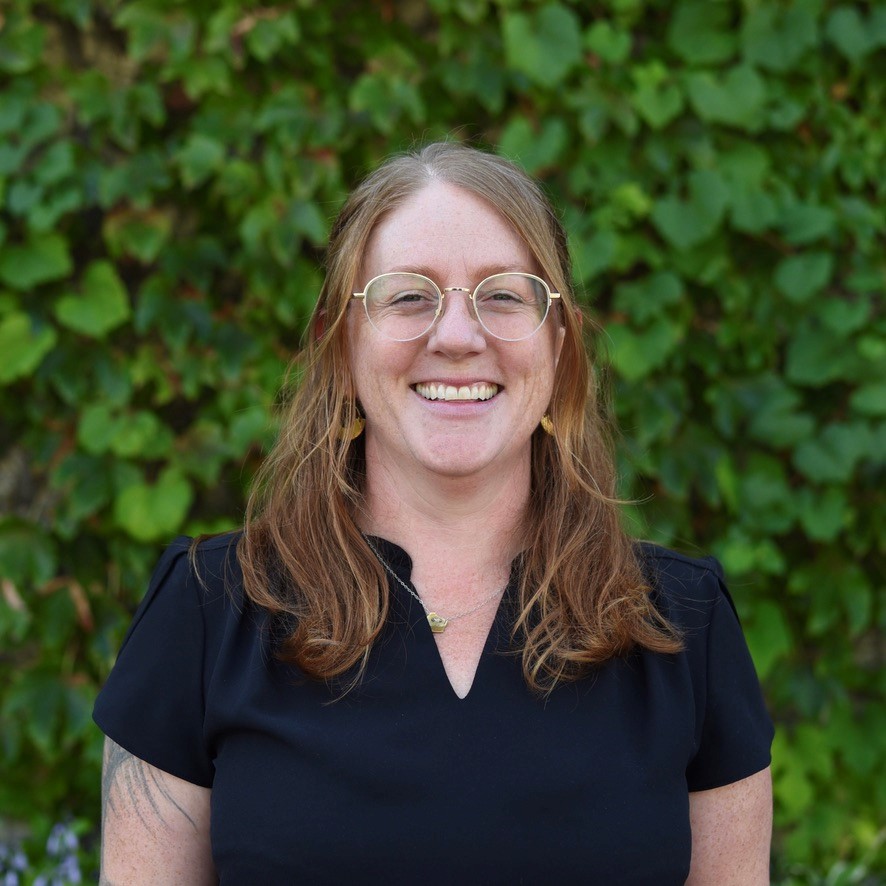
Chris McGuire Coordinator | Organic Fruit Growers Association
Rami Aburomia, Atoms to Apples Orchard
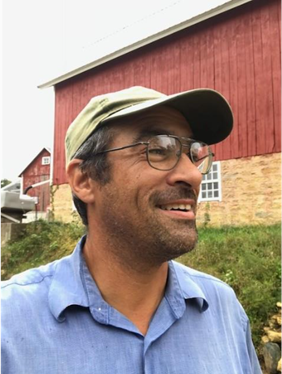
Rami Aburomia started growing apples 21 years ago as a manager of a U-Pick operation south of Madison, WI. That experience formed a base of knowledge about growing apples and running an apple business in Wisconsin. After searching for an appropriate orchard site, he planted an orchard on his own land in 2015 which was certified organic in 2017. The goal at Atoms to Apples is growing great apple and pear varieties and getting those fruits to customers at the peak of their freshness and flavor. There are 65 varieties of apples, pear, peach and plum varieties on the farm that ripen from early August to late October. Atoms to Apples marketing mix consists of farmers markets, add-on CSAs, wholesale and on-farm. The farm is mostly a one-person operation with more help in the fall. Rami tries to make the management as efficient as possible with a significant amount of mechanization for a small farm. Rami was a past board member of the Organic Fruit Growers Association and is currently on the board of the Wisconsin Apple Grower Association.
Rachel Henderson, Mary Dirty Face Farm
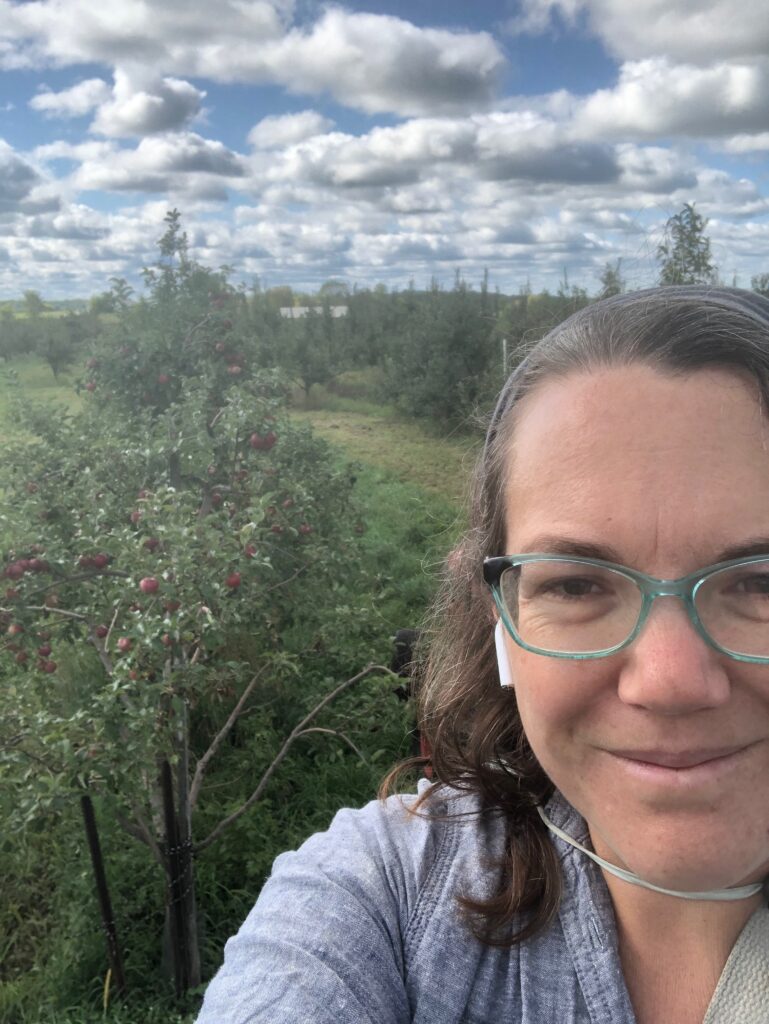
Rachel Henderson, with her husband Anton Ptak, grows certified organic tree fruit and berries on their farm in Menomonie, Wisconsin. They began planting their diverse orchard in 2009, and currently grow about 9 acres of fruit, including apples, pears, plums, currants, blueberries, and raspberries. They have experimented with other unusual fruits and have worked with different livestock in and around the orchard. With a focus on selling fresh fruit direct-to-consumer, most of their marketing is via farmers markets, CSA-style fruit shares, and small wholesale, along with some value-added products. They have been involved with OFGA since they started farming, and Rachel worked previously as an organic specialist with Marbleseed.
Peter Werts, IPM Institute of North America

As Department Director of Specialty Crops Grower Services at the IPM Institute of North America, Peter serves as the lead consultant working with apple farmers across the upper Midwest to help them implement bio-intensive IPM programs with a focus on strategies to sustainably manage crop pests. Additionally, Peter manages the Red Tomato EcoCertified™ program and outreach with other supplier initiatives to support IPM adoption and pollinator conservation in orchard systems. Since 2009, the SCGS team has been collaborating with experts in the industry to provide trusted and practical guidance for growing apples and stone fruit East of the Rockies.
Thank you to our sponsors!
Equipping farmers to build resilient farms and communities.

Since 1972, Ohio Earth Food has been testing soil and delivering the best soil amendments, fertilizers and disease and insect controls for your organic farm with two locations to serve you, NW Ohio and the driftless region of WI.
Innovative nutrient and crop production solutions, trusted by growers.
Need affordable refrigeration? CoolBot makes it possible. CoolBot is a smart microcontroller that pairs with a compatible window or mini-split air conditioner to cool a well-insulated space down to refrigeration temperatures. Build your own walk-in cooler and save thousands compared to traditional units. Join over 125,000 satisfied customers and start your DIY cooler build today.
Organic Apple Orchard Academy attendees get $25 off a CoolBot or CoolBot Pro purchase!

Located in New York and shipping across the U.S.A and Canada. We offer over 200 varieties of superior quality apple, pear, and stone fruit trees. Order now for spring deliver 2026 & 2027. Pre-Bud Orders for 2028.
All Energy Solar provides a full-service solar solution experience for commercial and government customers seeking to switch to solar energy. In addition to solar panels, we offer energy storage options along with EV charging helping businesses save money and reach their sustainability goals.

Koppert is a global leader in natural bumblebee pollination solutions and biological crop protection. By harnessing the power of beneficial insects, microorganisms, and biostimulants, Koppert helps growers reduce chemical inputs, improve soil health, and achieve higher yields sustainably. Our mission is simple: work with nature to make agriculture healthier, safer, and more productive for future generations.
With your Organic Apple Orchard Academy registration, you’ll be entered for a chance to win a quad pollination hive from Koppert.
Marbleseed educates, inspires, and empowers farmers to thrive in a sustainable, organic system of agriculture. Through its farmer-led conference, workshops, and field days, to its quarterly magazine, Marbleseed supports the small- and mid-sized farms that are the heartbeat of the local food system.
Nutrien Ag Solutions is the world’s largest agricultural retailer. We carry a large variety of organic products and orchard supplies. Contact Nutrien Ag Solutions in Galesville, WI today to discuss your orchard needs.
608-539-2090




The USDA Midwest Transition to Organic Partnership Program (TOPP) is a coalition of partners in Arkansas, Kentucky, Illinois, Indiana, Iowa, Michigan, Minnesota, Missouri, Ohio, Tennessee, and Wisconsin providing producers with local, experienced organic mentors; organic farmer training and education; access to organic technical assistance and training; organic workforce training and development and by expanding the organic community.